
When Stadiums Become Strategic Infrastructure
The Securitization of Global Sport
Strategic Friction
3/17/20262 min read
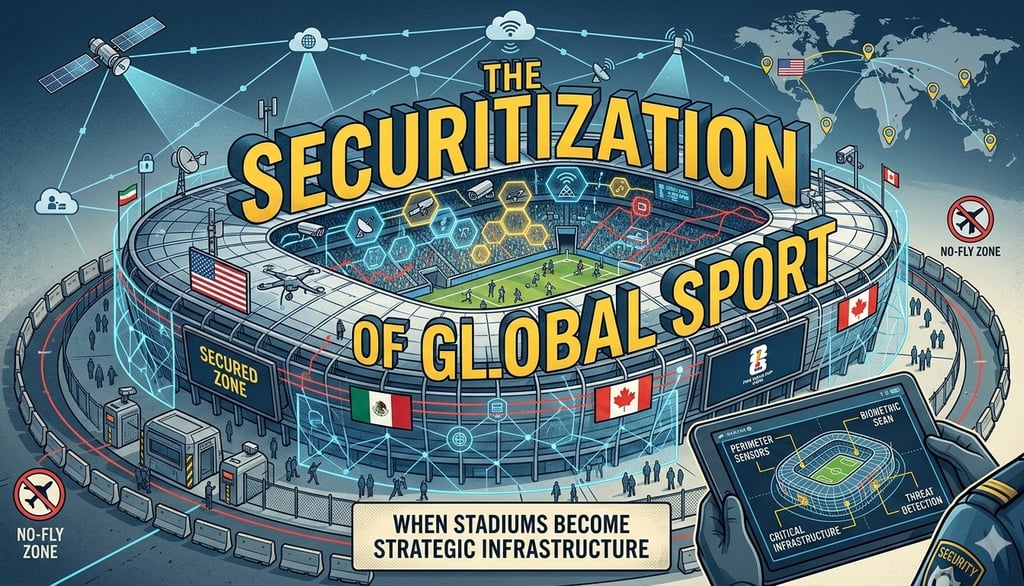
For much of the late twentieth and early twenty-first centuries, international sport functioned as a cultural safety valve. Competitions like the FIFA or Formula were designed to transcend; or at least temporarily suspend, global politics. The stadium was marketed as neutral ground: a sanctuary where fans from rival nations could celebrate a shared passion while governments quietly sidelined their disputes.
Today, that assumption is increasingly difficult to sustain.
Major sporting events are undergoing securitization; the process by which activities once considered purely commercial or cultural are reclassified as matters of national security, public order, and geopolitical signalling. Stadiums are no longer just entertainment venues; they have become pieces of strategic infrastructure.
Sport as Political Signalling
While international tournaments have always carried symbolic weight, the intensity of that symbolism has sharpened alongside global competition. Governments now view hosting rights, participation, and even ceremonial gestures as instruments of diplomatic messaging.
The friction surrounding proposed advocacy initiatives during the 2026 World Cup; such as themed matches involving teams from restrictive regimes - illustrates this tension. What begins as a local initiative can quickly evolve into a geopolitical flash-point.
In Western host cities, organizers frame these gestures as celebrations of universal values; however, opposing officials often interpret them as intentional political provocations.
Consequently, sporting events designed to unite audiences often become arenas where conflicting social values and national identities collide. For organizers, every symbolic gesture, from flags to opening ceremonies; must now be weighed for its diplomatic consequences as much as its PR value.
The Expanding Threat Environment
The physical security landscape has expanded dramatically. The tri-national hosting of the 2026 World Cup across the United States, Canada, and Mexico demonstrates how complexity multiplies across jurisdictions. Intelligence coordination and law enforcement authority vary significantly across these three borders.
In Mexico: Security concerns remain centered on the influence of organized crime. Historically, cartels have viewed high-profile public events as stages for visibility or disruption.
In the U.S. and Canada: The focus shifts toward "soft target" protection and cyber-resilience against state-sponsored disruption.
In Motorsports: Formula One faces similar constraints. Logistics planning now involves real-time monitoring of regional missile threats and maritime chokepoints. At the time of publishing, both the Bahrain and Saudi Arabian Grand Prixs have been called for the moment, and likely cancelled outright for the year.
The Rise of the “Security Economy”
An underexamined consequence of this shift is the emergence of a dedicated “security economy” surrounding major events. Delivery now depends on a layered ecosystem of intelligence agencies, federal policing bodies, private security contractors, cybersecurity firms, and biometric surveillance providers.
Financially, the scale is substantial. Security expenditures for major tournaments routinely exceed hundreds of millions of dollars, in some cases rivaling or surpassing capital infrastructure costs. These investments are no longer optional; they are prerequisites for host eligibility and insurance viability.
The Future: Controlled Spaces
The global appetite for spectacle remains, but the operational "back-end" has fundamentally changed. Future tournaments will likely feature:
Hardened Perimeters: Stricter accreditation and physical barriers.
Digital Vetting: Monitoring of fan activity and social media to preempt political flash-points.
Stability over Glamour: Governing bodies (FIFA, FOM) may pivot toward "safe-bet" hosts with proven security apparatuses, even if they lack the "emerging market" appeal of previous decades.
The stadium is no longer just a stage for athletes; it is a controlled environment where entertainment, diplomacy, and national security intersect.
While the view from the stands may look the same, the machinery keeping the lights on is becoming infinitely more complex.