The Visible Hand: Navigating the Era of State Capitalism
Has Your Competition become the Nation-State?
BUSINESSSECURITY RISK MANAGEMENTGEOPOLITICSCANADA
Strategic Friction
3/3/20264 min read
For decades, free-market capitalism operated under a comforting fiction: an "invisible hand" guiding economic outcomes toward optimal efficiency. Governments positioned themselves as impartial umpires, intervening only to enforce basic rules and maintain a semblance of fair play - or at least enough fairness to preserve public legitimacy.
That era is over.
The invisible hand hasn't simply been weakened; it is being replaced by something far more deliberate and conspicuous. States no longer want to referee from the sidelines; they want to play the game. Through sweeping industrial policies, strategic investments, and the emergence of governments as "Investors-in-Chief," we have entered a new paradigm: State Capitalism.
Neutrality is no longer the objective. Fairness no longer the pretense. Instead, governments across the developed world are openly selecting winners, acquiring equity stakes, and engineering market outcomes with unprecedented directness. The state is no longer hiding its hand; it is placing it firmly on the scales, determining not just the rules of competition, but the competitors themselves.
The Rise of the Sovereign Competitor
The transition is stark: we have abandoned laissez-faire economics for structural interventionism. Governments, regardless of political slant, are increasingly seeking to wield the "Golden Share" - a governance mechanism that grants the state veto power over critical decisions within ostensibly private companies.
To understand the friction this creates, look at the world's two largest economic powerhouses: China and the United States. Though they sit at opposite ends of the political spectrum, they are racing toward the same functional reality.
Two Models, One Destination
China: Control via Direct Ownership China’s approach is unambiguous: the state is the enterprise.
Entities like China National Petroleum Corporation or State Grid aren't merely influenced by the government; they are arms of it. The CCP (Chinese Communist Party) appoints executives and dictates strategy, using corporate balance sheets as policy instruments.
When Beijing decided to dominate solar manufacturing, State-Owned Enterprises (SOEs) flooded the sector with subsidized capital, operating at a loss for years until Western competitors collapsed. No shareholder concerns. No profit constraints. Just strategic patience backed by sovereign resources.
The United States: Control via Structural Leverage The American model is more subtle but arguably more pervasive: control without ownership through dependence and incentives.
Defense contractors like Lockheed Martin derive 70–90% of their revenue from the government. While technically private, their survival depends on Pentagon priorities.
The CHIPS Act: This Act exemplifies the new approach - $52 billion in available subsidies, but with "golden handcuffs" attached. Recipients must restrict stock buybacks, comply with "Buy American" rules, and share excess profits.
Intel no longer has to be nationalized because it now operates within a framework of incentivized compliance where national security supersedes the quarterly report (profit).
The "Proximity Tax" on Innovation
This shift has birthed what we call a Proximity Tax. Business success being increasingly determined by how close you are to political power rather than how well you serve your customers. This creates two primary distortions:
Labor Drain: State-subsidized "National Champions" cannibalize local talent, offering wages and benefits that independent firms—reliant on actual revenue—cannot match.
Zombification: Inefficient but "strategic" firms are kept on life support, blocking the path for more agile, local competitors to emerge.
A Canadian Case Study
Canada provides a textbook look at these distortions in a developed, democratic context.
The Bombardier Labor Drain: As a designated "National Champion," Bombardier has received billions in state support, such as the 2017 Quebec government investment of $1 billion in the C Series program. This allows them to offer compensation packages that draw top talent away from smaller aerospace firms. While it saves jobs in the short term, it creates an uneven playing field that stifles the broader dynamism of the sector.
SNC-Lavalin Zombification: Despite serious legal and ethical controversies, SNC-Lavalin continues to secure massive government contracts (like the $150 million SkyTrain project) due to its "strategic importance." By keeping an embattled player on life support, the government effectively signals that political scale matters more than corporate integrity, preventing more efficient, law-abiding firms from rising to take their place.
Business' Secret Weapon: The "Agility Alpha"
Elon Musk has navigated the Proximity Tax with remarkable finesse. SpaceX and Tesla operate in sectors - space, EVs, and energy; that are intricately entwined with government policy. Success in these sectors requires mastering technology and politics.
Musk leverages government interests (national security, climate goals) to secure lucrative contracts and subsidies that offset the massive risks of his long-term ventures. However, this creates a symbiotic vulnerability: Tesla’s fortunes are closely tied to political winds. A shift in environmental policy or a change in administration could upend the business model.
How to Outrun the State
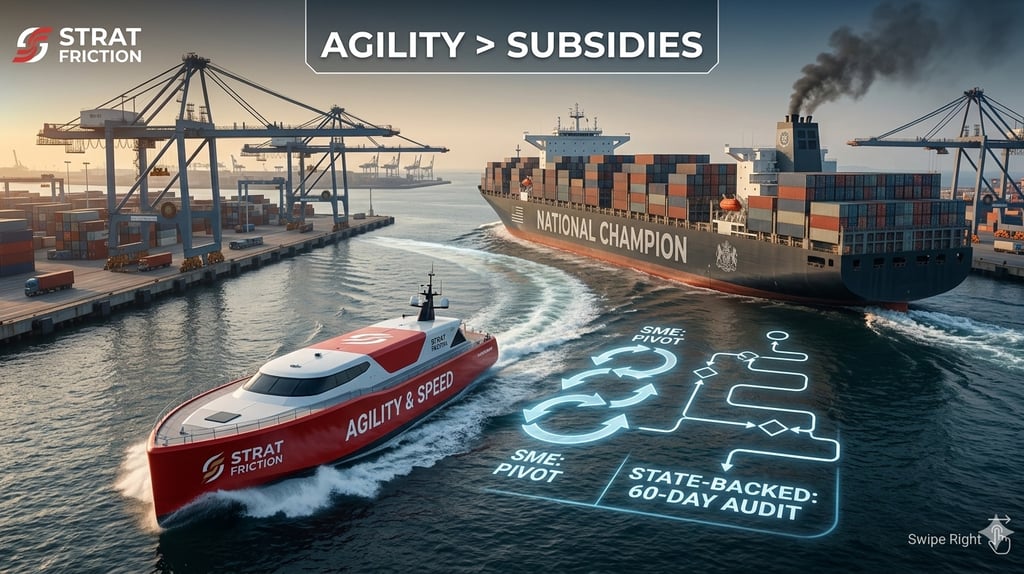
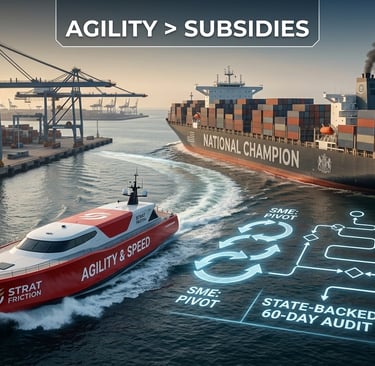
While private businesses cannot out-spend the government, they can out-run it. If your business lacks state backing, that independence may be your greatest advantage if played correctly:
The Speed Premium: Government-backed firms move at the speed of bureaucracy. Your ability to pivot and respond to market shifts in weeks, not years - is a premium service and key advantage.
Radical Specialization: Move into the "complexity gaps." Provide high-touch, nuanced services that are too small or too complex for state-backed giants to manage effectively.
IP Sovereignty: Position yourself as "Neutral & Private." Global clients are increasingly wary of "state-connected" tech back-doors. Your independence is your seal of trust.
The Takeaway
Friction is the new gravity. In this era of State Capitalism, being "too big to fail" often leads to complacency and the loss of market leadership. For the modern entrepreneur, the winning strategy may not be to wait for the invisible hand to return; but rather to become "too fast to catch."