The Sovereign AI Wall: Why Your Unified Tech Strategy is Crumbling
Master the friction between global innovation and national borders with your essential 2026 Sovereign AI Audit.
Strategic Friction
2/20/20262 min read
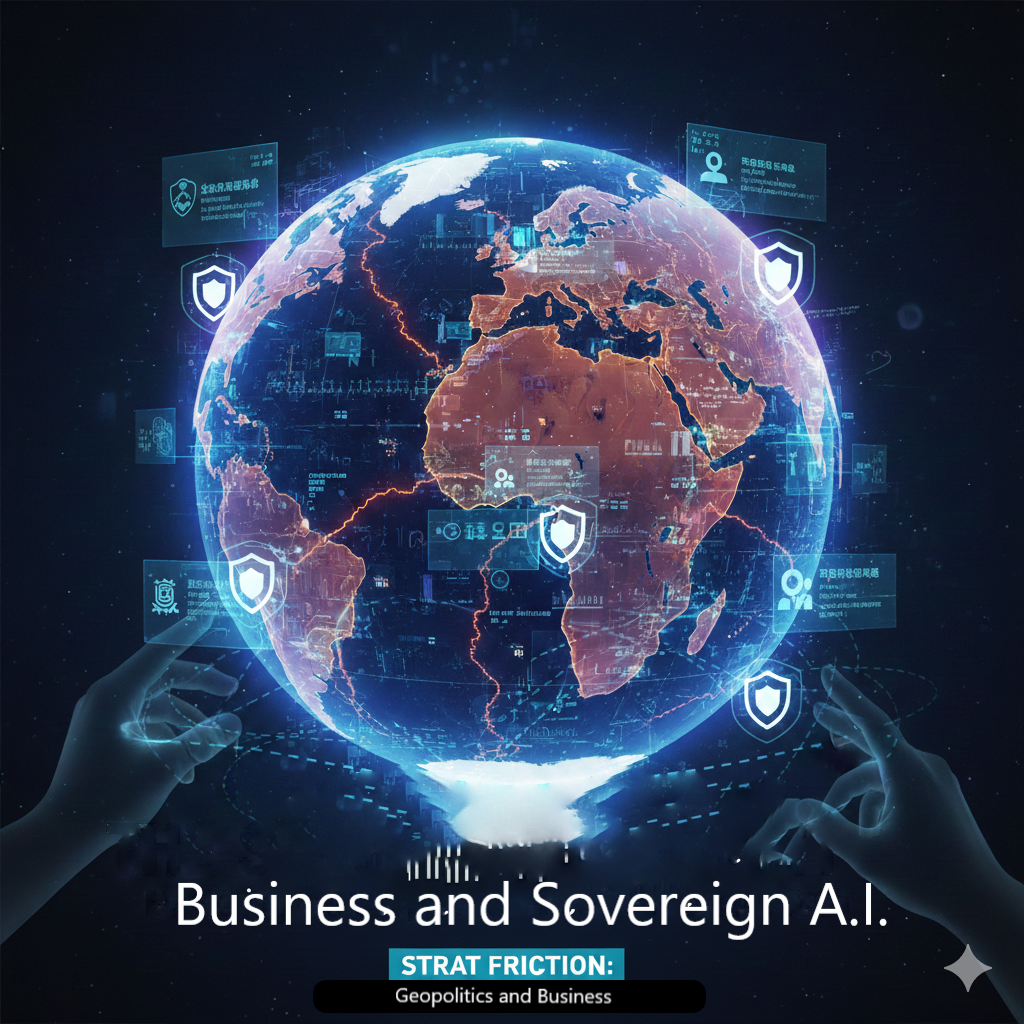
For decades, the "Global Tech" dream was simple: build a model in Silicon Valley or Shenzhen, host it in a central cloud, and serve the world. Efficiency was the god of the era.
But as we cross into 2026, that dream is hitting a wall; literally. Welcome to the era of Sovereign AI.
From "Splinternet" to "Silicon Borders"
While the 2010s gave us the "splinternet" (fragmented social media and censorship), 2026 has introduced something far more expensive for business: Digital Sovereignty. Nations are no longer content with just regulating content; they are demanding control over the "brains" of the modern economy and that is further complicating the risk landscape for business.
Today, countries like Canada, India, and France are moving beyond mere data residency and actively looking to create at minimum a framework within which A.I. will be expected to operate or at maximum increasingly influence if not outright control the A.I. ecosystem. Through initiatives like the Canadian Sovereign AI Compute Strategy and India’s IndiaAI Mission, governments are mandating that AI models be:
Trained on local, culturally relevant data.
Housed on domestically owned and operated "Sovereign Clouds."
Audited by local regulators to ensure alignment with national values, not just corporate ones.
The Friction: The Efficiency Death Spiral
For multinational corporations (MNC), this creates a massive operational friction point. If you’re a global bank or a manufacturer, your "unified AI strategy" is likely falling apart into a dozen localized shards.
The cost is staggering. Training a frontier model can exceed $100 million. If a company is forced to maintain a separate "Sovereign version" of its stack for the EU (to satisfy the EU AI Act), another for India, and another for Brazil, the economies of scale that made tech so profitable vanish.
The CEO’s Dilemma: Do you sacrifice model quality by using smaller, localized datasets, or do you sacrifice margin by paying for redundant infrastructure in every market?
The Strategic Pivot: Orchestrating the Constellation
Those businesses at the forefront of this new landscape are moving away from the "Monolith" model. Instead of one giant global AI, they are building a Hybrid Architecture.
Global Foundations: Use global models (like GPT-5 or Gemini) for general tasks that don't touch sensitive data.
Regional Inference: Deploy "Edge" nodes, local micro-data centers; to handle real-time processing and comply with local residency laws.
Federated Learning: Instead of moving data to the model, they move the model to the data, training it locally and only sending "insights" back to the center.
The Bottom Line
In 2026, "frictionless" is a fantasy. For Strat Friction readers, the takeaway is clear: Geopolitics has officially entered the server room.
If your AI roadmap doesn't have a "Sovereign" chapter, you aren't building a global business; you're building a liability.