The Myth of “Free” Sea Lanes
Global trade depends less on rules and markets than on control of the sea lanes that carry it, making maritime power a decisive factor in who trades freely and who does not.
GEOPOLITICS
Strategic Friction
1/23/20261 min read
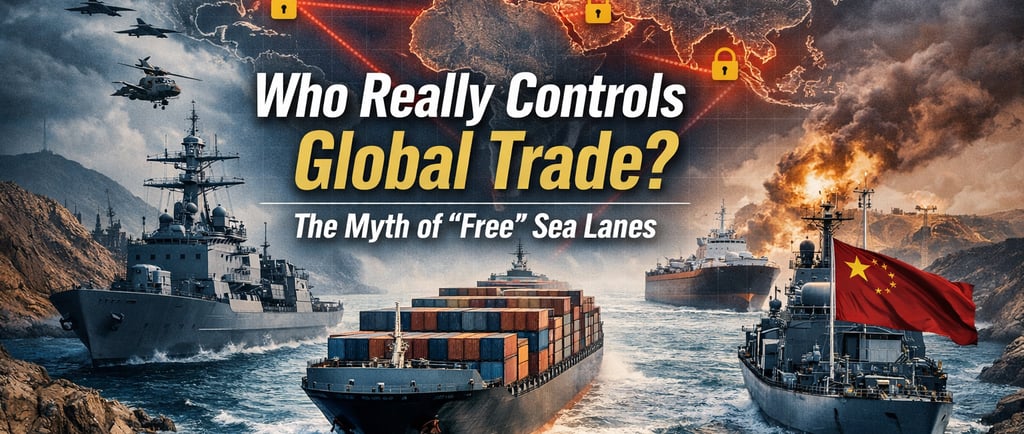
Who Really Controls Global Trade? The Myth of “Free” Sea Lanes
Global trade is routinely described as free, open, and rules-based. The assumption is that maritime commerce flows naturally, governed by international law and protected by collective norms. In reality, global trade moves at the discretion of power. Sea lanes are not free by default; they are controlled, contested, and occasionally denied.
Roughly 90 percent of global trade travels by sea, yet it is concentrated through a handful of maritime choke-points: the Strait of Hormuz, Bab el-Mandeb, the Suez Canal, the Malacca Strait, and the Panama Canal. Control; or credible influence over these nodes translates directly into economic leverage. Disruption does not require total closure; even limited interference raises insurance costs, delays shipping, and reshapes market behavior.
Naval power remains the ultimate guarantor of maritime access. Despite narratives suggesting a post-military global economy, the ability to project force at sea still underwrites trade stability. The U.S. Navy has played this role for decades, but that dominance is increasingly challenged. China’s naval expansion, Russia’s willingness to disrupt, and regional powers asserting control over adjacent waters are all symptoms of a system under strain.
What is often overlooked is that “freedom of navigation” is not a legal condition - it is a security outcome. It exists only where enforcement capacity, political will, and economic interests align. When those elements diverge, friction emerges quickly.
For corporations and states alike, the implication is clear: access to global markets is no longer guaranteed by globalization alone. Trade routes are strategic terrain.
Those who assume neutrality or permanence risk being surprised when power, not principle, determines whose ships move; whose do not.