The Geopolitical Pivot: From Background Noise to Boardroom Reality
Strategic Friction: Integrating Geopolitical Risk into Corporate Governance.
Strategic Friction
2/3/20262 min read

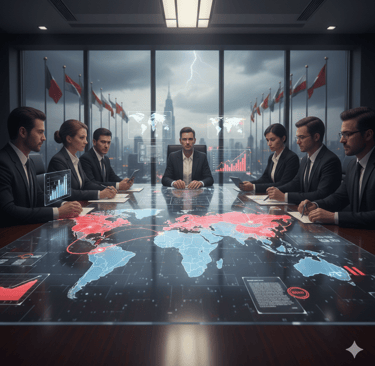
For decades following the Cold War, the private sector viewed geopolitics as background noise; a distant concern for diplomats and generals, but rarely a line item on a balance sheet. That era of insulation has ended. Today, geopolitical tension translates directly into operational, financial, and reputational risk, placing "strategic friction" at the very center of corporate governance.
The Speed of Disruption: Beyond Traditional ERM
Modern risk frameworks are struggling to keep pace with the weaponization of trade. Sanctions, export controls, and regulatory fragmentation now evolve with a velocity that can invalidate contracts and strand assets overnight. A single policy shift in Washington, Beijing, or Brussels no longer just "impacts" a market; it can fundamentally sever a supply chain or trigger immediate compliance crises.
This is not an abstract concern; it is measurable, material exposure. Traditional Enterprise Risk Management (ERM) models, built on historical probability, often fail to capture the non-linear shocks; sudden escalations or policy reversals - that define the modern era.
The Death of Neutrality: Corporations as Geopolitical Actors
Corporations are no longer passive observers; they are increasingly treated as; and behave as, geopolitical actors. Decisions regarding data sovereignty, technology partnerships, and market access are now scrutinized through a lens of national security.
Huawei and the 5G Cold War: Perhaps no company illustrates this better than Huawei. Once a global leader in telecommunications, it became the center-piece of the U.S.-China trade war. Banned from U.S. markets and restricted from accessing critical American-made semiconductors, Huawei was forced to pivot from a purely commercial entity to a driver of Chinese technological self-reliance. Its fate was decided not by consumer demand, but by a geopolitical tug-of-war over digital infrastructure.
Starlink: The Private Battlefield: SpaceX’s Starlink has redefined the intersection of business and war. By providing the primary communication backbone for Ukraine’s military during the Russian invasion, a private company suddenly held the power to influence battlefield outcomes. When its leadership made unilateral decisions to restrict coverage in specific regions; like Crimea, to avoid perceived escalation, it demonstrated that private corporate choices can now dictate the strategic limits of sovereign nations.
The "Digital Silk Road": Many Chinese tech giants are being drawn into the "Digital Silk Road" initiative, where their overseas infrastructure projects are viewed by the West as tools for expanding Beijing’s influence. Conversely, these firms face the friction of navigating domestic mandates to support national security goals while attempting to maintain global market share.
Strategic Friction: When Time Horizons Collide
Strategic friction emerges when corporate time horizons; often decades for infrastructure and R&D, collide with the extreme volatility of modern politics. In this environment, neutrality is an endangered posture. Silence or inaction is often interpreted as alignment, whether intended or not, forcing boards to navigate a landscape where every commercial choice carries political weight.
The power dynamic is also shifting. While states are "weaponizing" companies through sanctions, companies like Starlink or global semiconductor manufacturers are influencing political decisions by controlling the technologies that states now depend on for survival.
The Path Forward: Integration, Not Outsourcing
The implication is clear. Geopolitical intelligence can no longer be siloed in government affairs departments or outsourced to occasional consultants. It must be integrated into the DNA of executive decision-making and scenario planning.
In an age of systemic competition, the most resilient firms will be those that stop treating geopolitics as an outside threat and start managing it as a core business variable shaping long-term viability.