The Big Picture: From Order to Rupture
The global rules have been upended. Globalization is retreating to a collection of fortified economic zones. How are geopolitical necessities colliding with individual liberty and impacting business?
Strategic Friction
2/19/20265 min read
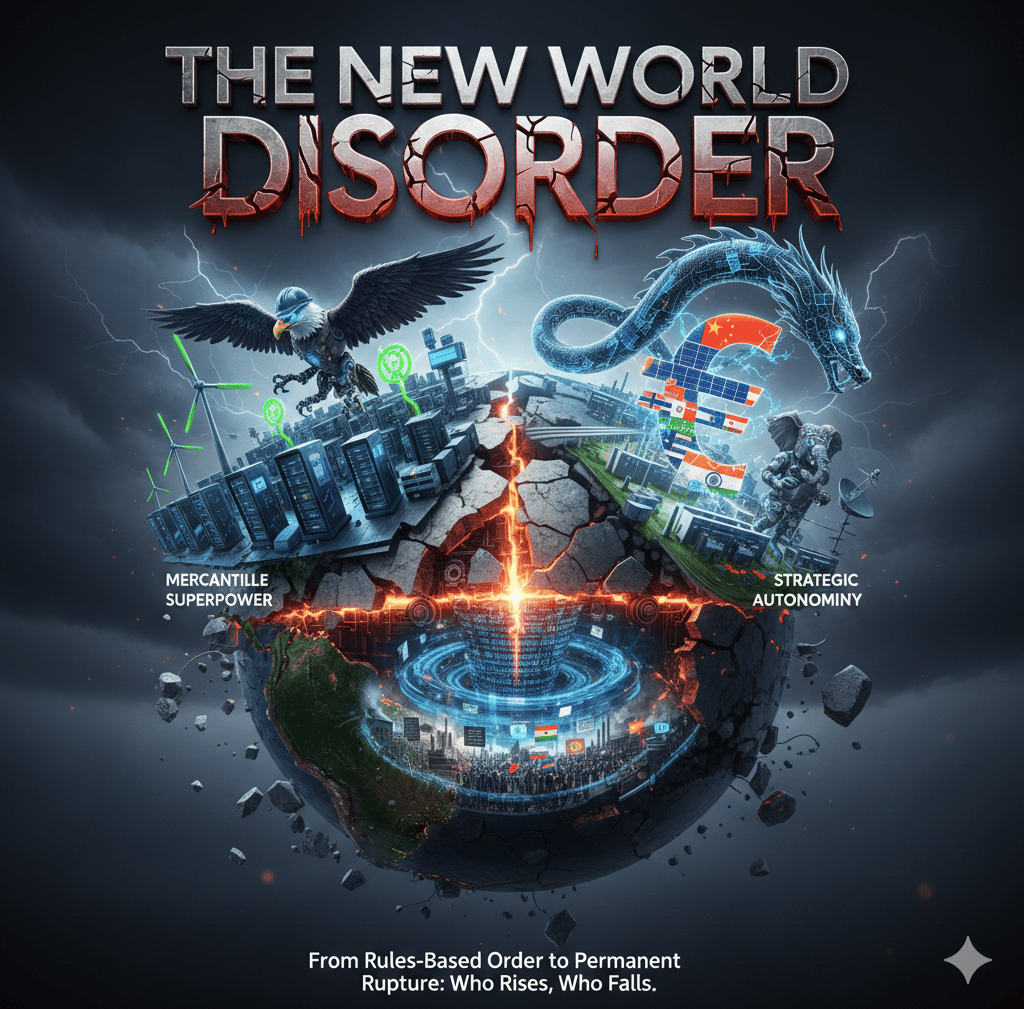
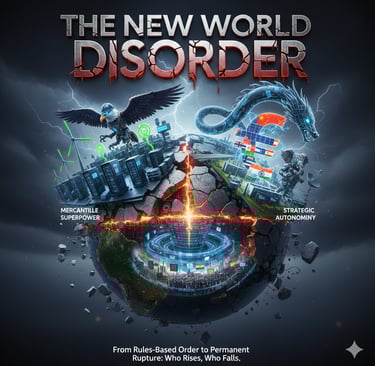
In 2026, the era of predictable, liberalized global trade has dissolved into a newly emerging Geopolitical Realism. Sovereign control over technology and transactional statecraft have been thrust back to the forefront of national security, now dictating the rules of international engagement.
We are witnessing not merely a destabilization of the old system, but a hard pivot toward a fragmented, high-stakes landscape where economic policy has become weaponized as part of a broader national security vision. That said, this isn't necessarily a "new" world so much as it is a return to an old one; as history's pendulum swings back toward mercantilism and sovereignty after three decades of globalist expansion.
1990–2010 (The Reach): The Era of Managed Optimism: Global governance took precedence over national resilience, underpinned by the belief that "a rising tide lifts all boats." This idea was aggressively promoted worldwide, driving a period of unparalleled trade growth and wealth accumulation. However, the tide was never truly uniform in its rise. Whether the theory was ever feasible remains uncertain, but what is undeniable is that the emergence of a K-shaped recovery has revealed the "rising tide" notion as little more than a convenient myth. While the ultra-wealthy reaped enormous profits through globalized arbitrage, the majority of people saw their economic security erode, local industries hollowed out, and their boats not lifted, but capsized.
2020–2026 (The Retraction): The "Zero-Sum" Pivot: As wealth concentration reached a breaking point and global institutions like the UN and WTO became increasingly impotent, the "common good" rhetoric of globalism was abandoned. In its place, zero-sum national security logic has taken hold, effectively fracturing the world into three primary economic spheres, each competing for sovereign control over technology, resources, and labor:
The Dollar-Donroe Zone (The Americas)
The Sinocentric Electrostate (China-led Eurasia)
The Strategic Autonomous Block (The European Union)
The Protagonists: Strategy vs. Risk (2026)
Core Strategy Primary Risk
US | Hemispheric Control: Aggressive reshoring and "The Social Volatility: Tariffs fuel inflationary spirals, deepening the Donroe Doctrine" to dominate the Western Hemisphere. "K-shaped" divide and Gen Z unrest.
China | Deflationary Involution: Exporting high-tech The Debt Trap: A shrinking population and global "walls" to (EVs/ Batteries) offset a collapsing domestic property market. against cheap tech floods stall growth.
Europe | Strategic Autonomy: Massive industrial investment Political Paralysis: Populist surges and "hybrid war" with (Draghi Plan) to pivot from consumer to producer. Russia drain financial and political will.
India | Multi-Alignment: Acting as the "Swing Power" Execution Gap: Bureaucratic stalling and climate vulnerability between the West and the Global South. threaten the "India AI" mission.
Impact on Business & Labor: The Resilience Mandate
The shift to "local-for-local" production, sometimes referred to as "friend-shoring," is a rational response to global instability. By shortening supply chains and sourcing materials locally, businesses can reduce their exposure to geopolitical risks. However, this move could also turn supply chains into tools for government policy, should governments choose to leverage their newfound influence to impose greater control over the economy.
The "Just-in-Time" delivery model, which optimized logistical efficiency and cost during the World's greatest economic expansion, has been abandoned for domestic systems designed to withstand sanctions and export controls. Redundancy is and flexibility is becoming the new standard. While this protects business against global shocks, it creates permanent structural inflation (as a result of having to use potentially higher cost options); a cost passed directly to consumers as a defacto "sovereignty tax."
Labor Bifurcation: The New Class Divide
The integration of AI into public and private services is creating a "K-shaped" labor market, stretching Canada's social fabric to its breaking point.
The Hollowed-Out Middle: Entry-level white-collar roles, the traditional path to the middle class; are being automated by the AI tools powering the Citizen Stack.
The Scarcity Trap: There is a desperate shortage of high-tier technical architects and skilled manual labor needed to build the physical reshoring infrastructure.
State Dependency: As roles vanish, the government uses its integrated digital ID system to distribute "Universal Basic Income" or "Reskilling Credits," effectively turning the displaced workforce into permanent wards of the state.
Societal Impact: The "Citizen Stack"
Governments worldwide are responding to global volatility by developing integrated "Citizen Stacks," which combine digital IDs, AI-driven public services, and tax systems into a single, unified infrastructure. In Canada, this integration is seen in the linking of provincial health IDs with modernized tax systems like the CRA. While this may streamline administrative processes, it also risks creating a "digital leash" that allows the government to:
Monitor Financial Behavior: Real-time tracking of citizens' spending patterns could provide the government with unprecedented insight into individual financial activity.
Gatekeep Access to Services: The state could deny or restrict access to essential services based on an individual's compliance with various regulations or behaviors.
Automate Dissent Management: A fully integrated system could make financial deplatforming as seamless as it was during the 2022 "Convoy" account freezes, where political dissenters had their accounts frozen in real-time.
This integration, while offering convenience, also introduces a significant "friction" between efficiency and privacy. The Citizen Stack promises a frictionless user experience, but at the cost of transforming society into a high-surveillance state. This becomes particularly concerning as reshoring policies continue to push prices up, leading citizens to demand that the government "fix" inflation, a problem it may have contributed to.
As the state responds with more interventions, it creates a cycle of increasing government control and the erosion of individual autonomy, something citizens in Canada should be cautious of, especially when drawing comparisons to China's approach to governance.
In China, similar systems have been implemented through the Social Credit System, where citizens are rewarded or penalized based on behavior, and access to services is often contingent upon conformity to government expectations. The Chinese government uses this integrated system not only for efficiency but also to enforce social control.
The potential risk in Canada is that, while it's not yet at the scale seen in China, the infrastructure is moving in that direction, and the same tools could be used for surveillance and compliance enforcement, especially in times of crisis or social unrest which the Government has already shown a willingness to use during the 2022 Covid Convoy protests in Ottawa.
Canadians should be wary of the unintended consequences of such integrations. While these systems may be presented as solutions to global challenges, they could ultimately undermine personal freedoms, creating an environment where individual behavior is constantly monitored and shaped by government priorities.
The Bottom Line: Success in 2026 and beyond hinges on one critical factor: adaptability. Businesses and individuals who can respond nimbly to the shifting geopolitical landscape will thrive. Those waiting for a "return to normal" are preparing for irrelevance.
The defining question is no longer if this new order will emerge - it already is. The real question is whether we actively shape it, or passively let it shape us. Worse still, will we allow government policies to mold our future in ways that work against our interests?
The choice is ours: lead the change, or be left behind by it.
The “Donroe Doctrine” describes an emerging U.S. strategy that updates the logic of the Monroe Doctrine by consolidating the Western Hemisphere into a secure economic and technological bloc.