
How Geopolitical Friction is Redrawing the Map of Global Sport
How Geopolitics turns high-stakes sports into volatile gambles.
Strategic Friction
3/10/20263 min read
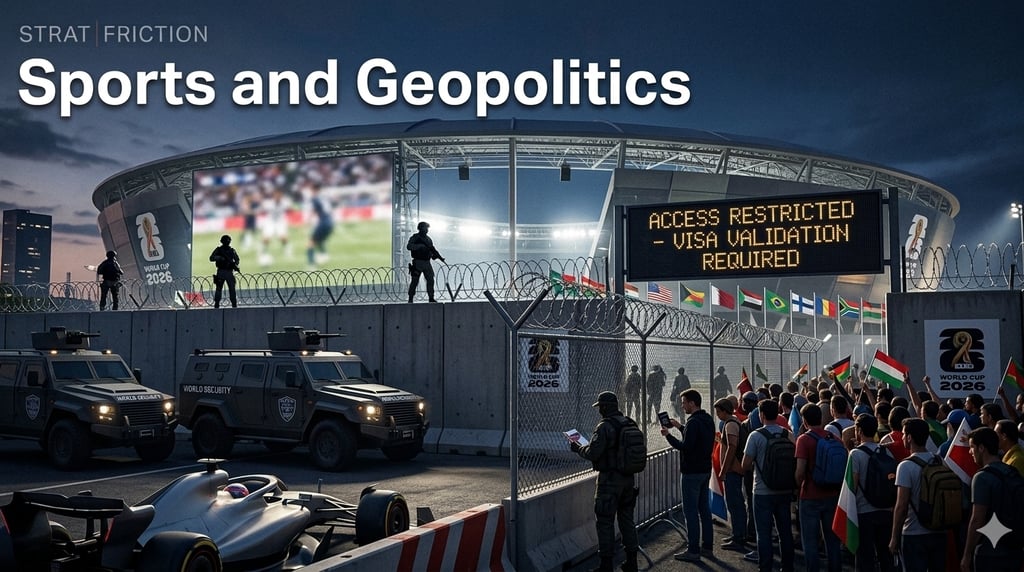
In the late era of globalization, major sporting events were treated as the world’s most frictionless entertainment product. Series such as the Formula One World Championship moved its travelling circus of teams, equipment, and personnel across borders with remarkable efficiency, while the quadrennial FIFA World Cup promised a month-long cultural holiday largely insulated from the political tensions shaping the broader international system.
For decades, audiences enjoyed these spectacles without much appreciation for how rare such seamless global coordination actually was.
That era is ending.
As geopolitical risk intensifies, sport is increasingly functioning as a mirror of state tension rather than an escape from it. The result is a structural shift: major events are no longer merely influenced by geopolitics - they are being reorganized by it. For sponsors, municipalities, and local businesses, the once predictable economic windfall of a host-city event is at risk of being a volatile and politically exposed asset.
Formula 1: Logistics in a Conflict Environment
Few leagues illustrate this shift more clearly than the Formula One World Championship. As the 2026 season opens in Melbourne, the escalating tensions surrounding the Iran–U.S.–Israel confrontation cast a shadow over the entire race calendar.
The Gulf region, once central to the sport’s expansion strategy; has become a logistical and security concern. The Bahrain Grand Prix at the Sakhir circuit and the Saudi Arabian Grand Prix in Jeddah were designed to showcase the sport’s new global markets. Today, however, the possibility of retaliatory missile strikes or airspace closures has turned these venues into operational liabilities rather than prestige destinations.
Teams have already begun rerouting cargo aircraft away from Gulf and Red Sea airspace. Equipment shipments that once moved directly between Europe and the Middle East are now detouring through hubs such as Singapore and Hong Kong. These logistical workarounds create what can be called a “geopolitical tax”; additional freight costs that disproportionately affect smaller constructors operating on tighter technical budgets likely leading to less competition if not outright race withdrawals.
If race cancellations occur, the commercial consequences will extend beyond the track. Sponsors who purchased exposure across a 24-race season face lost visibility, renegotiated contracts, and uncertainty about the sport’s global footprint. The impact at the local level will be no less significant with hotels, restaurants, tourism and anticipated tax revenues will evaporate.
World Cup 2026: Borders, Politics, and Symbolism
The challenges confronting the 2026 FIFA World Cup are less about missile threats and more about political friction. Marketed as a unified North American tournament hosted by United States, Canada, and Mexico, the event is encountering growing strains across immigration policy, domestic security, and cultural politics.
One of the most contentious flash-points emerged from a proposed “Pride celebration match” involving the Iranian national team. Advocacy groups in several host cities have promoted the concept as a symbolic statement on inclusion. However, officials from Iran; where LGBTQ expression remains heavily criminalized, have condemned the idea as political provocation. The resulting dispute highlights a broader dilemma for tournament organizers: global sporting events increasingly sit at the intersection of Western social activism and states whose legal frameworks reject those norms.
Security concerns extend beyond symbolic politics.
In Mexico, a series of federal operations against cartel leadership has triggered retaliatory violence across multiple states. Although host cities such as Guadalajara and Mexico City remain central to the tournament plan, escalating clashes between security forces and organized crime groups have forced contingency planning within the organizing committee. Discussions about shifting additional matches north to Canadian and US venues, particularly Toronto or Vancouver; reflect the uncomfortable reality that internal security conditions can now reshape international tournament logistics.
Implications for Local Economies and Business
For the local sports bar owner, hotel operator, or street vendor, the message is straightforward: treat the promised economic boom with measured caution. Major tournaments once functioned as predictable tourism catalysts. In the current geopolitical environment, however, that revenue potential is increasingly offset by a growing “security tax”, higher policing and security costs, increased insurance premiums, and operational uncertainty.
In practical terms, modern stadiums are beginning to resemble sovereign checkpoints rather than open civic venues. If the broader international system continues moving toward fragmentation and strategic competition, the world’s biggest sporting events will reflect that transformation; smaller in scope, more heavily secured, and far more expensive for the communities asked to host them.