From Employer to Moral Actor: How Employees Came to Believe They Can Define Corporate Belief
A brief examination of how values; driven by corporate culture, social media dynamics, and generational shifts have led employees to challenge who defines organizational direction - and how that tension is reshaping the modern workplace.
Strategic Friction
2/11/20263 min read

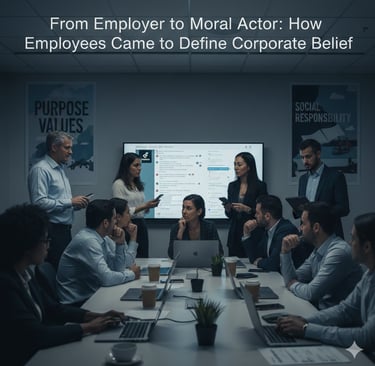
Across many organizations, a quiet but consequential shift has taken place. Employees increasingly feel entitled, not merely permitted; to influence what their company believes, supports, or condemns in the public sphere.
What leadership often experiences as overreach or ideological pressure is, from the employee perspective, a logical extension of how modern work has been framed. This dynamic did not emerge spontaneously. It is the product of deliberate cultural choices, technological reinforcement, and generational conditioning, and it is now reshaping the social terrain of the workplace - most visibly in the breakroom.
The first and most significant driver is the moralization of corporate identity. Over the past decade, organizations moved aggressively away from describing themselves as neutral economic entities and toward branding built on purpose, values, and social responsibility. Mission statements expanded beyond service delivery to include ethical commitments, social impact, and global awareness. Recruitment messaging promised alignment of personal and organizational values, encouraging employees to see work as an extension of identity rather than a transactional exchange. Once companies positioned themselves as moral actors, employees began to view themselves as moral stakeholders. In that context, challenging leadership is not insubordination; it is perceived as values enforcement.
This shift altered the psychological contract of employment. Compensation and role clarity were supplemented; sometimes even replaced by expectations of ethical coherence. When a company speaks publicly on one issue but remains silent on another, employees do not interpret this as strategic restraint. They interpret it as inconsistency. The sense of entitlement arises not from arrogance, but from perceived breach. If values are part of the brand, employees believe they have standing to demand fidelity to them.
Technology has amplified this mindset. Social media has normalized the idea that institutions respond to pressure from below. Individuals watch corporations, governments, and public figures adjust positions in real time after online backlash. Authority appears porous and reactive. Internal collaboration platforms replicate these dynamics inside organizations. Slack channels and internal forums function like miniature public squares, where consensus is asserted through volume, repetition, and moral framing. The tactics of external activism; open letters, collective statements, call-outs; are imported wholesale into corporate life.
This erosion of hierarchical deference is further reinforced by generational experience. Many younger employees entered the workforce during periods of sustained crisis: pandemics, geopolitical conflicts, climate emergencies, and economic instability. They were socialized in environments where institutions were portrayed as either failing or untrustworthy unless actively challenged. Loyalty became conditional and instrumental. If employment is viewed as temporary and replaceable, there is little incentive to defer to long-term corporate strategy or reputational risk. Voice becomes the primary currency of influence.
These forces converge most clearly in informal workplace spaces. The breakroom, once a neutral zone for decompression, now serves as a testing ground for ideological alignment. Conversations are no longer just personal; they are interpreted as signals of corporate belief. Employees assess not only what colleagues think, but what the organization implicitly tolerates. Self-censorship increases, not because people are disengaged, but because the social cost of misalignment feels higher than silence. Teams fragment into affinity clusters, reducing trust and informal collaboration.
Managers are often caught in the middle. Many lack clear guidance on whether they are expected to mediate, suppress, or facilitate these discussions. Intervening risks appearing partisan; staying silent risks being interpreted as endorsement. Performance management becomes distorted as interpersonal tension bleeds into evaluations, framed in the language of “values fit” rather than behavior or outcomes.
The impact is cumulative. Productivity suffers not from disagreement itself, but from ambiguity around authority and boundaries. When employees believe they have a mandate to define corporate belief, leadership’s role becomes reactive rather than directive. Decisions are delayed, messaging becomes cautious or performative, and trust erodes on all sides.
This dynamic is not easily reversed, nor is it entirely negative. Employees who care deeply about values can be a strategic asset. However, organizations that invite moral engagement without clearly defining decision rights create the conditions for constant internal friction. Once belief is treated as a shared asset, it will be contested.
The modern workplace is learning, often belatedly, that asking employees to bring their whole selves to work also means confronting the question of who ultimately decides what the organization stands for.