Carney’s Crystal Ball vs. Canada’s Kitchen Table: Why “Real” Inflation Is Driving a 2026 Small-Business Survival Economy
A grounded look at how official economic optimism collides with declining purchasing power, currency weakness, and real-world inflation: forcing Canadian businesses into survival mode in 2026.
GEOPOLITICSCANADA
Strategic Friction
1/27/20262 min read
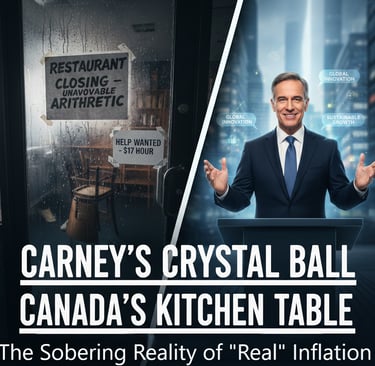
Carney’s Crystal Ball vs. Canada’s Kitchen Table: Why “Real” Inflation Is Driving a 2026 Small-Business Survival Economy
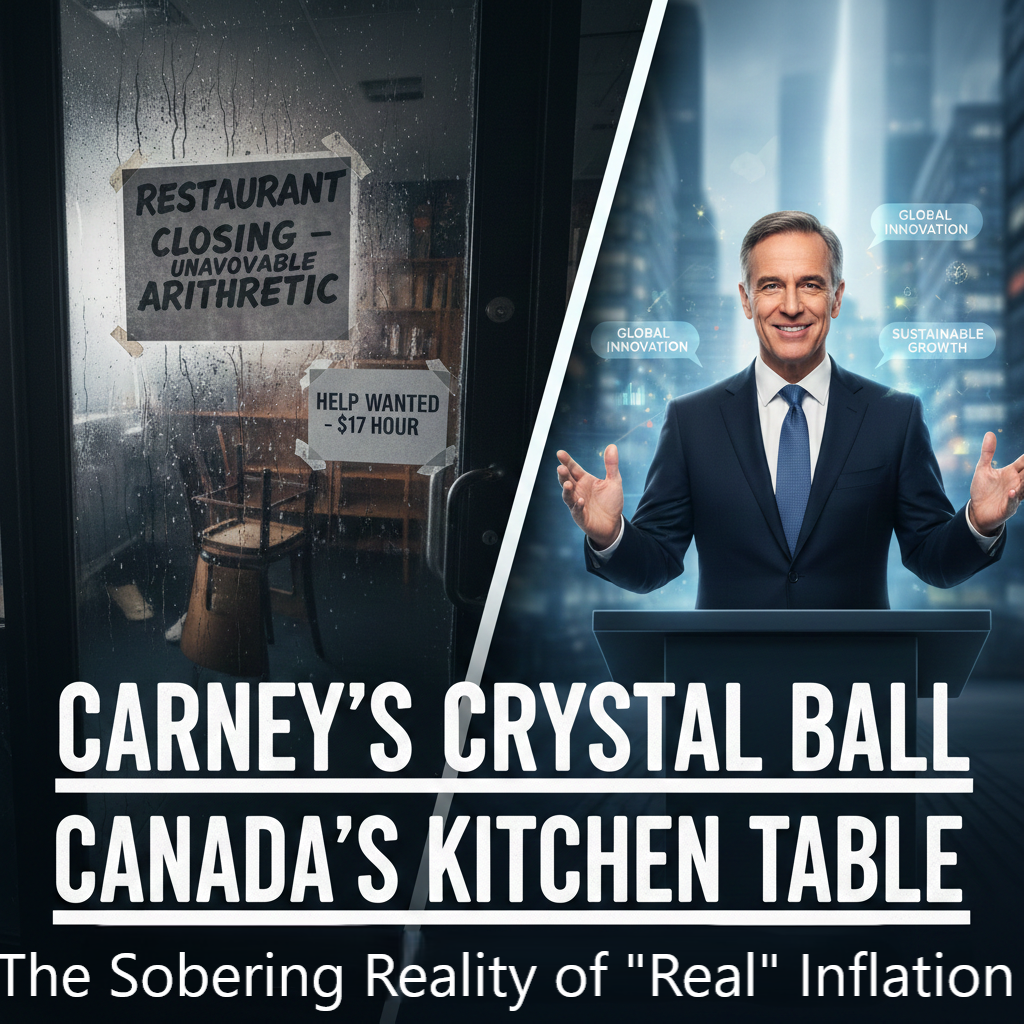
By 2026, Canada’s business environment increasingly reflects a K-shaped reality. At the top end, policymakers and financial leaders speak confidently about long-term transitions; sustainability, innovation, and global economic repositioning. Mark Carney, former Governor of both the Bank of Canada and the Bank of England, has emerged as a leading voice in this narrative, frequently framing Canada as a stable, forward-looking economy navigating global change.
At the kitchen-table level, however, a different Canada is being lived.
Official inflation metrics suggest stability. Canada’s headline CPI has moderated into the low-to-mid 2% range, consistent with central bank targets. From a monetary policy perspective, this appears to signal success. Yet for households and small businesses, inflation is not experienced as an aggregate index—it is felt through non-discretionary costs.
Food prices alone have risen materially since 2021, with cumulative increases well above headline inflation. For lower- and middle-income households, food represents a disproportionately large share of spending, pushing experienced inflation into the high single digits simply to maintain baseline living standards.
This is not a lifestyle adjustment; it is a structural pressure.
Compounding this is currency weakness. A Canadian dollar trading in the low-$0.70 USD range effectively imports inflation across food, appliances, consumer goods, and business inputs. For small retailers and service operators, this translates directly into higher cost of goods sold, margin compression, and customer trade-down behavior.
The deeper issue is not inflation alone, but what can reasonably be described as a prosperity deficit.
On a GDP-per-capita basis, Canada now trails the United States by roughly 30%, according to OECD and World Bank comparisons. This gap matters operationally: even with similar prices, Canadian consumers and employers have materially less economic capacity to absorb shocks. In several regions, the mismatch between cost of living and income-generating capacity is more severe.
Ontario now combines near–U.S. cost structures with far lower productivity outcomes. The Maritimes face structural disadvantages tied to interprovincial trade barriers and import dependence. Even Alberta’s relative strength remains exposed to commodity volatility.
This disconnect between macro vision and lived reality has practical consequences. Retail theft trends, inventory loss, staffing instability, and declining discretionary spend are not anomalies—they are rational responses to eroding purchasing power.
For business, survival in 2026 is no longer about optimism or alignment with long-term national strategies. It is about protecting margins, securing physical assets, managing currency exposure, and adapting to a consumer who is poorer in real terms - even if the CPI says otherwise.
Until economic leadership more directly reconciles vision with lived experience, the gap between the podium and the kitchen table will continue to widen; and businesses will remain on the front line of that divide.