The Critical Role of Deep Water Control in Global Shipping
In an era where "smooth" globalization is failing, Strategic Friction deconstructs how the battle for deep-water control dictates corporate survival, proving that those who secure the world's maritime choke-points ultimately write the rules of global trade.
Strategic Friction
1/29/20263 min read
Deep Water Control: Where Global Trade Meets Strategic Friction
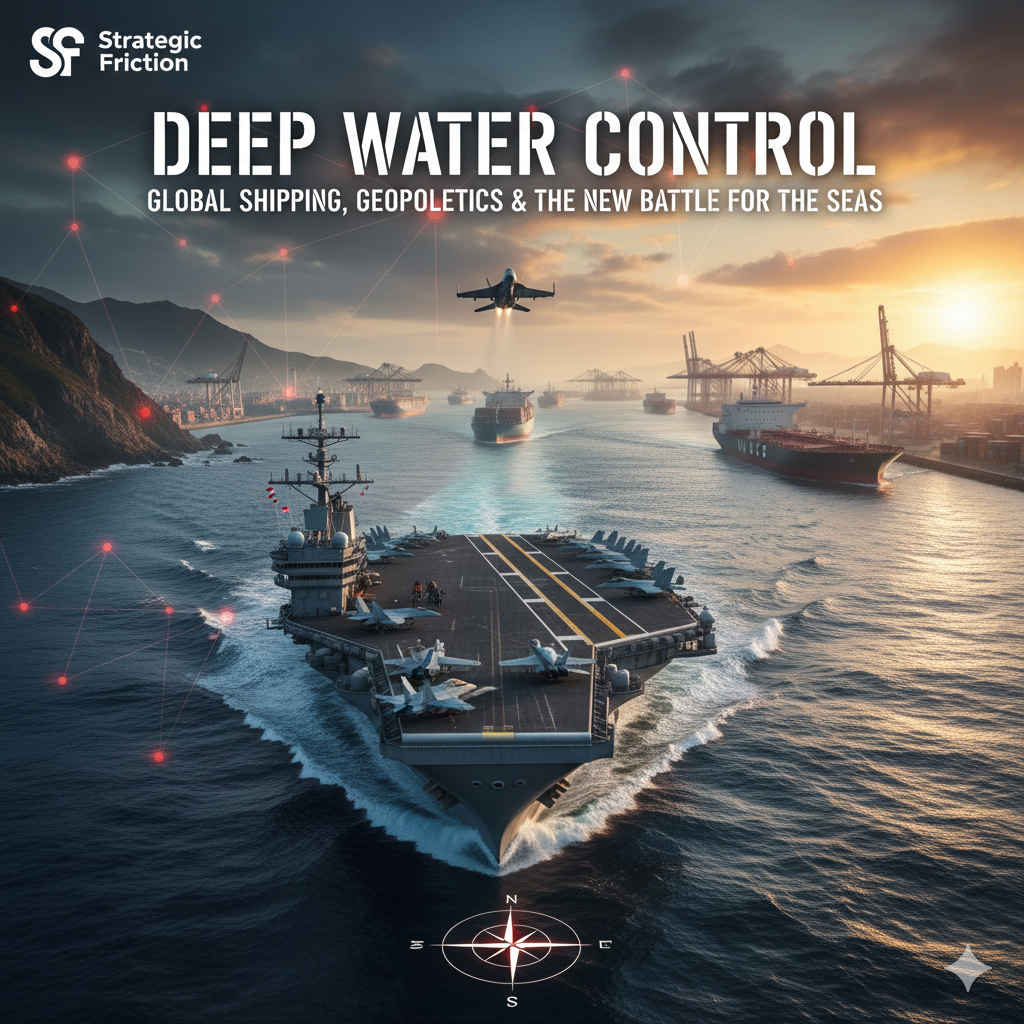
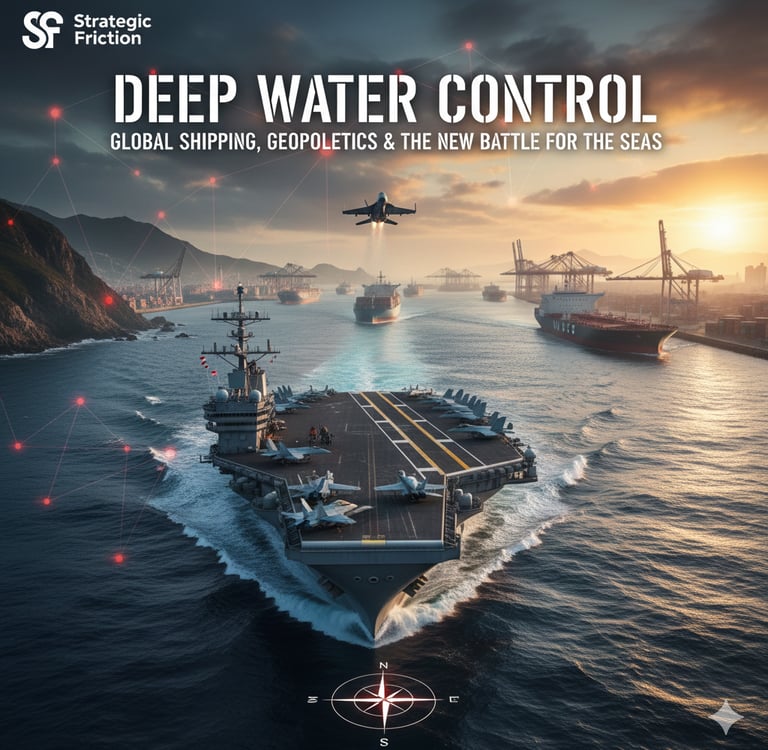
In the world of Strategic Friction, where global events and corporate reality collide, few arenas are as volatile as deep-water shipping routes. These "blood vessels" of global commerce carry over 80% of international trade. To understand the current heat in the maritime domain, one must look beyond the cargo and to the mechanics of Deep Water Control.
Global discussions on power competition frequently center on access to resources like oil, gas, and critical minerals. Yet these assets are inert without the ability to move them to where they can be sold, processed and sold. Maritime waterways are the connective tissue of the global economic system that allow this to happen. Strategic friction arises when access to these "tissues" becomes contested, introducing cost, risk, and uncertainty into the boardroom.
The Strategic Value of the Deep
Control over deep-water routes is the ultimate lever of global power. Unlike shallow littoral waters, deep-sea lanes allow for the movement of massive VLCCs (Very Large Crude Carriers) and ultra-large container ships.
Control isn't just about presence; it's about the ability to ensure "Freedom of Navigation" for yourself while maintaining the capacity to interrupt it for an adversary. Whoever secures critical choke-points like the Malacca Straits, the Suez Canal, the Bab el-Mandeb, and increasingly the Arctic passages - effectively holds a veto over the global economy.
A single disruption; whether from geopolitical conflict, piracy, or coercive state behavior; generates cascading effects well beyond the waterways. States that secure these routes reduce friction for their own economies while retaining the ability to impose pressure on others.
Why Now?
The era of "smooth" globalization is over. We have entered a world where trade is being weaponized. Two factors have accelerated this rush for control:
The Death of the "Playbook": Recent disruptions; from Houthi missile attacks in the Red Sea to droughts in the Panama Canal, prove that legacy "crisis playbooks" are obsolete.
National Security Infrastructure: Supply chains are no longer just commercial; they are geopolitical infrastructure. Nations are "near-shoring" production, requiring newly secured, resilient maritime corridors.
Technological change has further intensified this friction. Precision weapons and unmanned platforms have increased the vulnerability of surface fleets, making the projection of power more complex and high-stakes than ever before.
What This Means for the Boardroom
For international corporations, "Strategic Friction" in deep water means the end of predictable logistics.
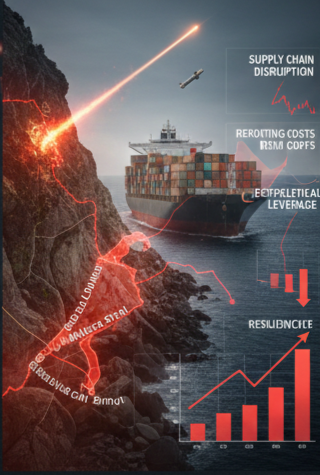
The Increased Cost of Friction: Rerouting to alternative routes like the Cape of Good Hope isn't just a delay; it’s an explosion in fuel costs, insurance premiums, and carbon emissions.
Political Alignment: Companies are increasingly forced to choose "trade blocs" and shorten supply lines. Sourcing decisions will increasingly be dictated by which navy can protect the route.
Vulnerability to Resilience: To stay defensible, corporations must move away from "Just-in-Time" models toward "Just-in-Case" contingencies.
The Bottom Line: Resources determine wealth, but the waterways determine power. In a world where risk never sits still, deep-water control is the ultimate prize.
For the executive, the message is clear: evolve your maritime strategy, or risk being stranded by the tide of history.
A Shifting Tide
Throughout history, a singular truth has remained constant: the state with the most sophisticated "Blue Water" navy dictates the terms of global civilization. This is the ultimate expression of Strategic Friction; using maritime dominance to control the flow of wealth and influence.
The lineage of power is unbroken. From ancient Greek Triremes securing the Mediterranean and the Viking longships projecting fear across the North Atlantic. Evolving into the Spanish Galleons that funnelled the wealth of the New World into Europe and the British Battleships that turned the entire globe into a singular marketplace.
As the famous anthem Rule, Britannia! once asserted, "those who rule the waves, rule the world." Today, that mantle is held by the American Carrier Strike Groups, the modern titans of power projection. In every era, the result is the same: the masters of the deep water don't just protect trade; they define its rules, secure its markets, and wield a disproportionate veto over the international system. Today's power players:
The United States: Remains the primary guarantor of maritime stability through its carrier strike groups and global basing architecture.
The Challenger: China is rapidly evolving from a commercial giant into a maritime power. While its naval footprint is growing, China has already secured "Geo-economic Control" by investing in nearly 100 ports worldwide. This creates a new type of friction: the ability to influence logistics through ownership rather than just kinetic force.
Regional Powers: India, Japan, and others are expanding their reach through cooperative security arrangements, creating a more multi-polar and complex maritime landscape.